Health screening in Seoul for expats, from the NHIS checkup to a more complete one
If you live in Korea and are enrolled in national health insurance, you're generally eligible for the NHIS checkup and cancer screening. This post covers what that includes, where it stops and how a comprehensive health screening in Seoul can add what your family history and symptoms call for.
Your Korean coworkers mention their geongang geomjin, the national health checkup, about as casually as a dentist visit. Then a friend at another company books a whole day of scans at a private center. Search for health screening in Seoul and you'll find both, and it isn't obvious which one is meant for you.
They do different jobs. The national program checks everyone of a certain age for a set list of conditions, while a comprehensive screening is built around one person's age, family history and symptoms. If you live here, you can use both.
Can foreigners in Korea get the NHIS health checkup?
If you're enrolled in Korea's National Health Insurance Service (NHIS), generally yes. NHIS says foreign nationals registered with immigration who work at a workplace covered by national health insurance are enrolled as employees. Since 16 July 2019, foreign residents who have been in Korea for more than six months also have to enrol, depending on their visa type.
NHIS offers its general health checkup to employees and to self-employed members, including householders and family members aged 20 or over. It describes the general checkup as fully covered, and it covers most of the cost of cancer screening as well. To check your own eligibility, call the NHIS English line on 033-811-2000.
What the NHIS cancer screening covers, and how often
NHIS publishes these intervals for its main cancer screenings.
| Cancer | From age | How often |
|---|---|---|
| Stomach | 40 | Every 2 years |
| Breast | 40 | Every 2 years |
| Colorectal | 50 | Every year |
| Cervical | 20 | Every 2 years |
These are tests designed for whole populations. Colorectal screening in the national program, for example, starts with a stool test called a fecal immunochemical test (FIT) rather than a colonoscopy. A 2024 study of nearly six million people, published in Cancers, found that people aged 50 to 74 who had ever been screened this way were less likely to die of colorectal cancer. That alone is a good reason to keep up with the national schedule.
Where a national health screening stops
The UK's NHS has a clear explanation of what screening can and can't do. It looks for a higher chance of a condition in people who seem healthy. A normal result means your risk is low for now, which isn't the same as never getting the condition. A higher risk result leads to further tests to confirm it, and because screening tests are not perfect, they can lead to some difficult decisions.
A fixed national list also doesn't change with your family. If your father had a heart attack at 50, or your mother has dementia, the national schedule stays exactly the same. And if you already have symptoms, screening isn't the right route at all. Book a consultation rather than waiting for your next checkup.
When comprehensive health screening in Seoul adds something
Kwangdong Hospital's Premium Checkup is designed for people based in Korea. You start with a base program, and precision modules are added after a consultation about your age, family history and current symptoms. The hospital says it doesn't recommend tests you don't need, and its checkup center lists a reason plenty of people will recognise. "My company checkup always says everything is fine."
The modules follow common worries. Heart disease in the family points toward the heart module, with cardiac ultrasound and a coronary calcium CT. Dementia in the family points toward the neurodegeneration module with a brain MRI and cognitive tests. Frequent headaches lead to the cerebrovascular module, an unsettled stomach to the digestive module with sedated endoscopy, and a cough that won't go away to the respiratory module with a low-dose chest CT.
There are also modules for hormones, functional medicine, disease genetics and sudden cardiac death prevention.
More tests aren't automatically better, though. Our post on what a full body checkup in Korea tests looks at where extra tests stop helping.
Who reads the results, and what happens next?
The test items are designed by a program development board chaired by Hospital Director Dr. Sang-Heon Cho. Its physicians planned and ran the Seoul National University Hospital Gangnam Center. On the day itself, endoscopy is on B2 and imaging on B1, so you never leave the building.
Images get a second reading by radiology specialist Dr. Jae-Hong Yoon, and specialists in Gastroenterology and Family Medicine lead the results consultation. Anything available on the day is explained that day. The more detailed items are reviewed at a second consultation 7 to 10 days later, which is easy to make when you live in Seoul.
If something abnormal turns up, you're connected to the right department in the same building. If you need surgery, you're referred to a partner tertiary hospital, and recovery and longer term care come back to Kwangdong.
Using the national checkup and a private screening together
Think of the national program as your baseline and keep doing it on schedule. A comprehensive screening can then add whatever your own history calls for. To avoid paying twice for the same thing, bring your last NHIS results to the consultation so repeated items can be discussed.
It also helps to write down your family history, meaning which relative, which condition and how old they were when it started. Add any symptoms, even small ones, and how long you've had them, plus a list of your medicines and doses in English or Korean. When you book, ask whether your national checkup can be done on the same day at the same hospital. A coordinator then guides you through test preparation.
If you're visiting from abroad for a short stay rather than living here, the hospital recommends the Global Premium Checkup instead. Our post on how long a health checkup in Seoul takes covers that schedule.
Booking a health screening in Seoul
Kwangdong Hospital is open weekdays 09:00 to 17:30 and Saturdays 09:00 to 13:30, and closed on Sundays and public holidays. It's at 612 Bongeunsa-ro in Gangnam, one minute from Bongeunsa Station, Exit 5, near COEX.
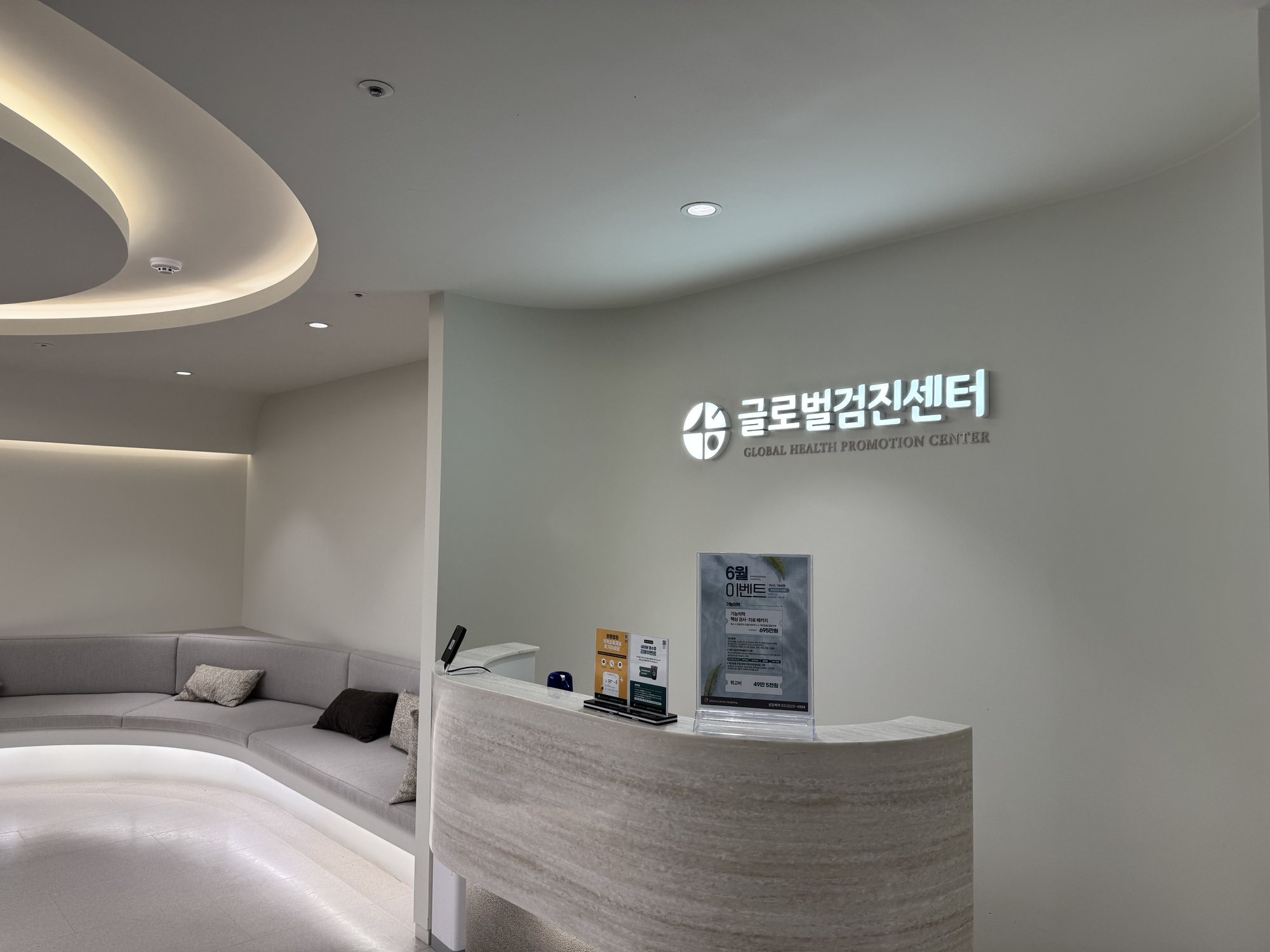
Coordinators speak English, Japanese, Russian, Chinese and Mongolian. Details are on the Premium Checkup page, the Global Health Checkup Center page and the visit page. Send your age, your main family history and your last checkup summary on WhatsApp, and the coordinators can suggest which modules are worth talking about.
Frequently asked questions
Is the health checkup free for foreigners in Korea?
If you are enrolled in Korea's National Health Insurance, NHIS describes the general health checkup as fully covered and most of the cost of cancer screening as covered. Eligibility depends on your enrolment, so check with NHIS, which has an English call line. A comprehensive private screening is separate and is not part of that coverage.
How often should I have a health screening in Seoul?
For the national program, NHIS sets the intervals, for example stomach and breast cancer screening every two years from age 40. How often to add a comprehensive screening depends on your age, family history and earlier results. Ask at the pre-checkup consultation rather than repeating the same package each year.
What is the difference between the Premium Checkup and the Global Premium Checkup?
Kwangdong's Premium Checkup is for people based in Korea and combines a base program with the precision modules you need. The Global Premium Checkup is for visitors on a short schedule and bundles accommodation, coordinators in five languages and follow-up after you return home.
Can I get my results explained in English?
Kwangdong has coordinators who speak English, Japanese, Chinese, Russian and Mongolian. Results are explained by specialists in Gastroenterology and Family Medicine. Ask at booking how interpreting will work for your results consultation.
What should I bring to a health screening?
Bring your last checkup results, a list of medicines with doses, and notes on family history and any symptoms. After you book, a coordinator guides you through test preparation. These details are what the pre-checkup consultation uses to choose your tests.
Sources
- Health Promotion: Health Checkup · National Health Insurance Service (NHIS), Korea
- Guidance for foreigners · National Health Insurance Service (NHIS), Korea
- NHS screening · NHS
- Effectiveness of the Korean National Cancer Screening Program in Reducing Colorectal Cancer Mortality (2024) · Cancers (Basel)
Written with AI assistance from Kwangdong Hospital's published center and program information and the medical sources listed. Not yet reviewed by a physician.